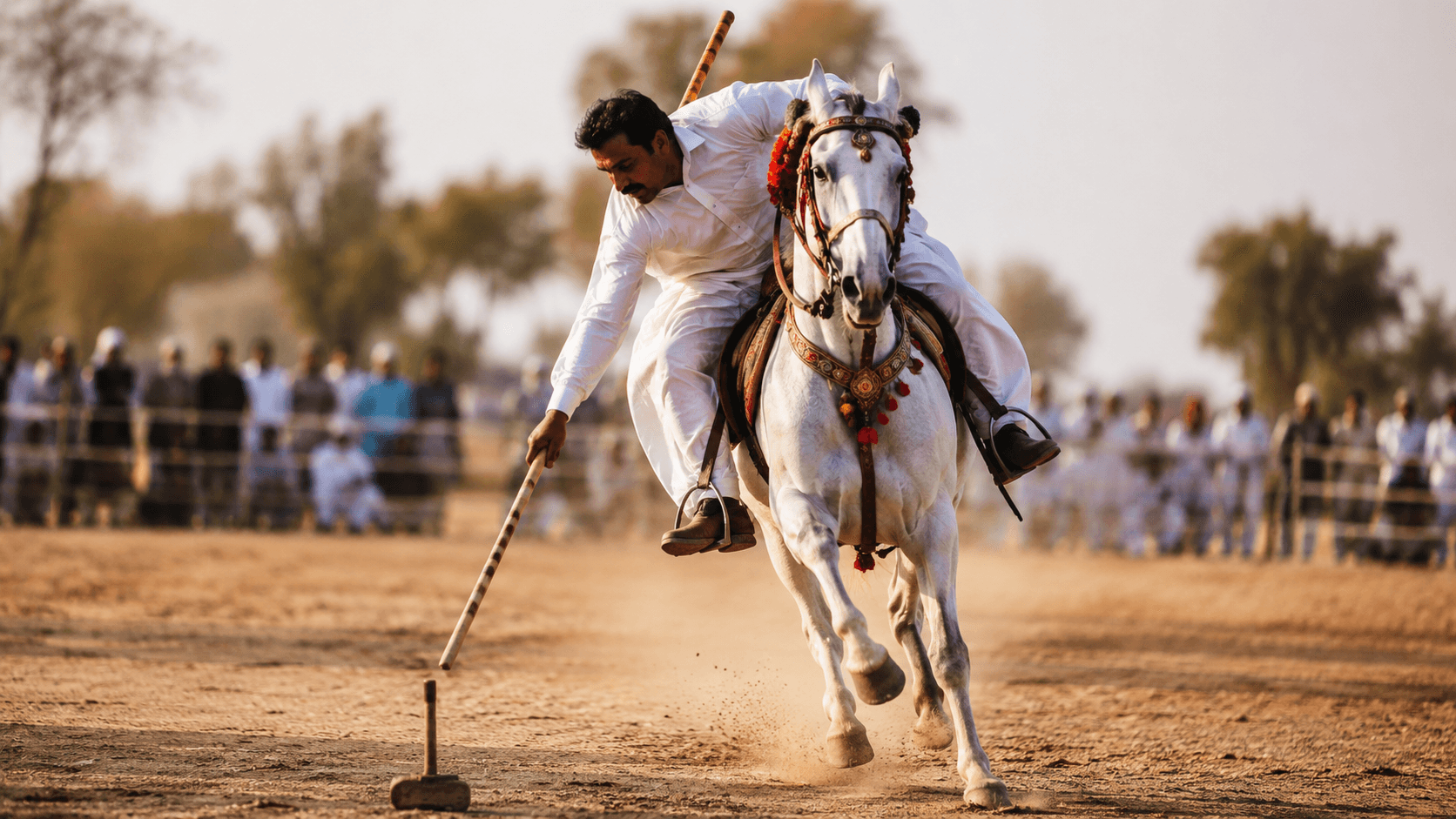
Some games in Pakistan are really difficult to understand until you see them in local events. You might have heard of them, you might have read about it, and even seen short clips of them online, but the real feeling comes when you are standing on the side of the ground, little dust is rising, people are standing, and a horse starts running from far away. That is the kind of moment people associate with tent pegging. In Pakistan, most people know it by its local name, Neza Bazi or نیزہ بازی. A racing game where the objective is to collect small targets with a lance by striking them with a sword while moving at full gallop. The audience also participates in the event by cheering or booing based on their judgment on the rider's performance or the target that was or was not struck. The action is fast and the people are engaged.
A Game That Feels Close to Rural Life
Neza Bazi fits naturally into Pakistan’s rural culture. In many areas, people have grown up around animals. Horses, cattle, goats, camels and birds are not just seen as animals kept somewhere in the background. They are part of homes, farms, work, income and sometimes family pride. A horse gets even more attention. You've got all sorts of comments. There are comments on gait, on stance, on neck shape, if it listens to the rider, if it looks fresh or tired, etc. At a mela or livestock event, you’ll see even more talks about the horses long before the actual competitions even begin. This is why Neza Bazi has stayed alive. It gives people a chance to see a horse and rider doing something that needs real practice. It is not just decoration. It is not just speed. It is control.
What Actually Happens in the Ground
The idea is simple enough. A small peg is fixed in the ground. The rider starts from a distance and rides toward it while holding a lance or sometimes a sword. As the horse reaches the target, the rider has to bend slightly, aim properly and strike at the right moment. If the peg is lifted or hit cleanly, the crowd knows immediately. If the rider misses, that is clear too. There is no confusion, no long explanation and no waiting for a replay. Maybe this is why the game is so easy for ordinary people to enjoy. Different events may have different rules. Some are simple village-level competitions. Others are more organized, with proper scoring, teams, timing and fixed distances. But the basic excitement remains the same. A horse runs, a rider aims, and one small target decides the result.
The Horse Is Not Just Part of the Show
Many people watching from outside focus only on the rider because the lance is in his hand. But anyone who understands horses knows the animal is carrying half the story, maybe more than half. A horse used in this game has to be brave without being wild. It should run straight, respond quickly and stay calm even when the area is full of noise. In local events, there may be loudspeakers, drums, children running around, motorbikes nearby and other horses waiting close to the ground. Not every horse can handle that.
This is why training matters. A good horseman does not start with speed on the first day. He first builds trust. The horse learns basic commands, gets used to the rider, understands the ground and slowly becomes comfortable with faster movement. Only then does target practice begin. A fast horse may impress people for a moment, but a calm and trained horse is what the rider really needs.
Care Comes Before the Game
While this section may be overlooked, it shouldn’t be. Horses that are not properly cared for simply cannot perform. Being properly fed, having clean water, being groomed, resting, and having their hooves cared for all matter. The saddle matters too. If a saddle does not fit well, the horse may feel discomfort or pain, or may move pain or discomfort. Before any type of event, horse owners that are more experienced usually examine the horse carefully. They check the legs, the back and examine the mood of the animal as well as the horses response. For horses who look weak, tired, or injured, they should not be pushed to perform. Winning a round is not worth harming the animal. Decoration is also common in Pakistani horse events. It looks beautiful and adds colour to the gathering. But even decoration should be sensible. Anything heavy, tight or irritating can disturb the horse while running. The animal’s comfort should come first.
A well-cared-for horse does not only perform better. It also shows confidence. You can often see it in the way the animal moves.
Why People Still Gather to Watch It
In the age of phones and short videos, it is interesting that people still enjoy standing in the sun to watch a traditional horse game. But maybe that is exactly the reason. It feels real. There is no editing. No filter. No second take. The rider gets one chance, and everyone sees what happens. For rural communities, such events are also a social occasion. People meet old friends. Horse owners discuss animals. Young boys watch senior riders and quietly imagine themselves doing the same one day. Older people compare today’s riders with the riders they saw years ago.
This is how a sport stays alive. Not because someone writes a rulebook, but because people keep showing up.
Why This Topic Matters for Animal Lovers
For readers who are interested in animals, this game has a deeper lesson. A horse is not prepared for Neza Bazi in one day. It needs time, food, training, care and patience. The rider must understand the animal, not just control it. That is also why this topic connects well with Pakistan’s wider animal culture. People who care about horses often care about feed, grooming, veterinary advice, breeding, training and safe handling. The game is only the visible part. Behind it is a whole lifestyle built around animals. Platforms like Mannddi are useful in this space because animal ownership should not be treated only as buying and selling. People also need knowledge. They need to understand what healthy care looks like, what responsible handling means and why animals perform better when they are respected.
A Tradition Worth Keeping, But Responsibly
Neza Bazi is a proud part of Pakistan’s horse culture. It has energy, beauty and history. But like every animal-based activity, it should be practiced with responsibility. A rider should never treat the horse like a machine. A good horse is a partner in the game. The best performances come when the rider and horse trust each other. You can feel that difference. The run looks smooth, the horse stays straight, and the rider does not look rushed. That kind of performance is not luck. It comes from daily work that most spectators never see. Tent pegging deserves attention because it keeps a traditional skill alive. It brings people together, gives value to trained horses and reminds us of Pakistan’s strong link with rural animal culture. If this game continues with better care, safer training and respect for horses, it will not remain only an old tradition. It will stay a living part of our culture.
FAQs
What is the meaning of tent pegging?
Tent pegging is an ancient equestrian sport of hitting, pulling or lopping small objects from the ground with a lance or a sword while mounted on a horse.
What is the name of tent pegging in Pakistan?
Neza bazi (or نیزہ بازی) is the term used for tent pegging in Pakistan.
Is Neza Bazi only about speed?
No. Speed helps, but the game also needs balance, timing, control, training and confidence between the horse and rider.
Where is this game commonly seen in Pakistan?
It is commonly seen at rural melas, horse shows, livestock events and traditional gatherings in different areas of Pakistan.
Why is horse care important in this sport?
Horses have specific requirements that must be met to help them have the strength and confidence to perform effectively and to help ensure the safety of everyone involved. Proper feeding, resting, grooming, and health inspecting all contribute positively to the overall condition of the horse.